
Inverters from 1500W to 3000W sit in the middle of the range. They are strong enough to run a refrigerator, a microwave, a coffee maker or power tools, yet they are still small enough to fit in an RV, a van or a garage. People buy them for emergency home backup, for off-grid cabins and for job sites where mains power is not available.
This hub collects every 1500W, 2000W and 3000W inverter we have reviewed. Use the top-rated table for a quick shortlist, then open the full review to see the specs, the pros and cons and what real buyers say. The guide below explains how to pick the right size, because buying too small is the most common and most frustrating mistake.
Our top-rated picks
| Model | Power | Our rating |
|---|---|---|
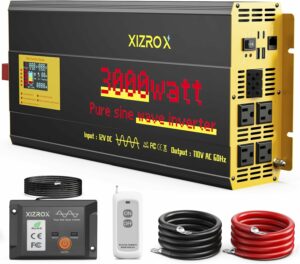
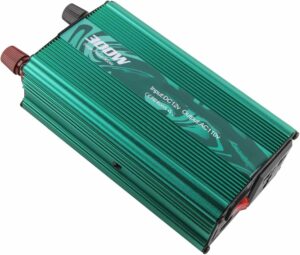
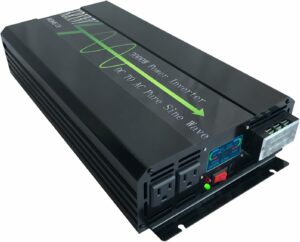
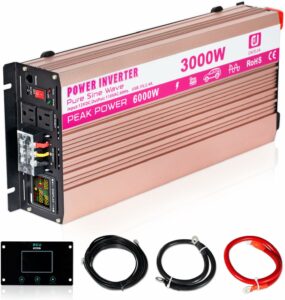
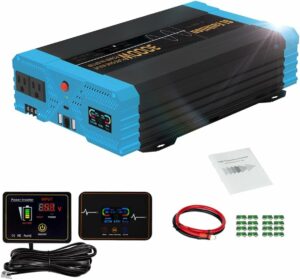
| XIZROX 3000W 12V to 120V Inverter | 3,000W | ★★★★★ 4.5/5 |
| Cobra 2500W Portable Power Inverter – USB DC 12V to AC110V Inverter | 2,500W | ★★★★★ 4.5/5 |
Ratings are our own scores based on the listed specs and verified buyer feedback.
How to choose a 1500W to 3000W inverter
Start with start-up surge
Motors and compressors need much more power for a moment when they start. A refrigerator that runs at 150W can briefly ask for two to three times that, and some pumps and air conditioners ask for even more. Your inverter needs a surge rating that covers the biggest start-up load, not just the running watts.
Match the battery voltage
These inverters are made for 12V, 24V or 48V battery banks. A higher voltage means lower current for the same power, which allows thinner cables and less heat. At 12V, a 2000W inverter can draw well over 150A. At 24V that falls by half, and at 48V by half again. For 2000W and above, a 24V system is often the better choice if you are building from scratch.
Use pure sine wave for anything valuable
At this size you are likely running refrigerators, power tools, TVs and computers. Pure sine wave output is gentler on all of them. Modified sine wave models are cheaper, but motors can run hotter and louder, and some electronics will not work properly.
Plan the wiring properly
A 2000W inverter on a 12V battery needs thick copper cable, a correctly rated fuse or breaker, and short cable runs. Poor wiring is the main reason these systems underperform or become unsafe. If you are not sure, ask a qualified electrician to check the installation, especially if the inverter will feed a home circuit.
What can these inverters run?
| Appliance | Typical running power | Suitable size |
|---|---|---|
| Refrigerator | 100–250W (surge 2–3x) | 1500W |
| Microwave (1000W class) | 1400–1800W input | 2000W |
| Coffee maker | 800–1200W | 1500W |
| Circular saw or angle grinder | 1000–1800W | 2000W–3000W |
| Window air conditioner | 500–1500W (high surge) | 2000W–3000W |
| Well pump | 750–1500W (high surge) | 3000W |
Wattages are typical figures. Always check the label on your own appliance.
Common mistakes to avoid
The most common mistake is sizing for running watts and forgetting surge. The second is using an undersized battery bank. A 2000W load can drain a small battery in minutes, so check the amp-hour rating of your battery as well. The third is skipping the fuse. Always fit a fuse or breaker on the positive cable close to the battery.
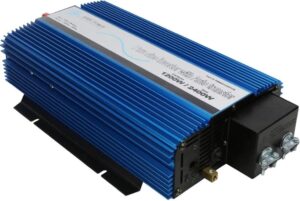
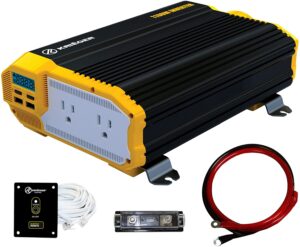
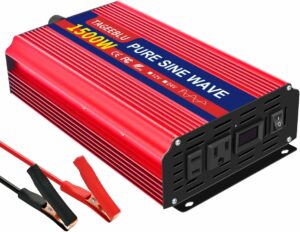
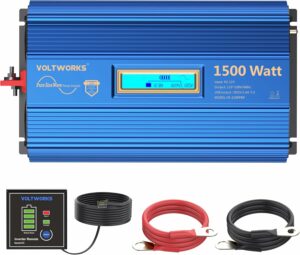
1500W inverters


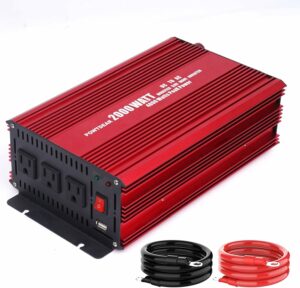
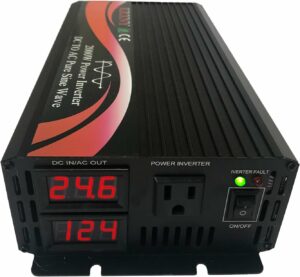
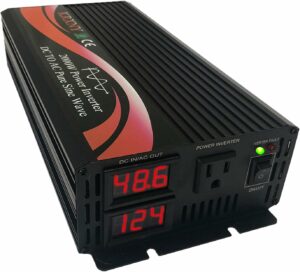
2000W inverters


2500W–3000W inverters

Frequently asked questions
What can a 2000W inverter run?
It can run a refrigerator, a microwave, a coffee maker, a TV and most power tools, as long as you do not run too many at the same time. Always add up the watts of everything running together.
Is a 3000W inverter worth it over a 2000W?
If you need to run a well pump, a larger air conditioner or several appliances at once, yes. For simpler needs, 2000W is usually enough and costs less.
How big a battery do I need?
Divide the inverter load in watts by the battery voltage to get amps. A 1500W load on a 12V battery draws about 125A, so a small battery will run out quickly. Larger lithium or deep-cycle banks are the usual answer.
Can I connect an inverter to my house wiring?
Only through a properly installed transfer switch, done by a qualified electrician. Never plug an inverter into a wall outlet to power a house circuit.
Pure sine wave or modified?
Pure sine wave for anything with a motor or electronics. Modified sine wave is acceptable only for simple resistive loads.