
Quick answer: The Renogy Bifacial 115W 12V Solar Panel at a glance: bifacial design; 115 Watts power. Pros buyers mention: bifacial design; captures light from both sides — main con: needs careful planning.

This is the Renogy Bifacial 115W 12V Solar Panel as the seller shows it. It is rated for 115W on a 12V system.
The Renogy Bifacial 115 Watt 12 Volt solar panel is a great choice. It can power many things. Think of it as a tiny sun you can take anywhere. It soaks up sunlight from both sides. This makes it more efficient than regular panels. You can use it for your RV, boat, or farm. It even works for off-grid homes. The Renogy Bifacial 115 Watt 12 Volt panel helps keep your batteries charged. This means you can use your lights and small appliances longer.
This solar panel is built to last. It is rigid and strong. It can handle tough weather. Rain or shine, it keeps working. Many customers are happy with it. They say it is easy to install. The Renogy Bifacial 115 Watt 12 Volt panel offers good value. It helps you save money on electricity. Plus, you are using clean energy from the sun. This is good for the planet. It’s like having a superpower that helps the Earth.
If you need power on the go, this panel is available. It is useful for your vehicle or even a remote camera. While it might not power a microwave for a whole month, it can handle smaller loads. The science behind it is clever. It uses high-efficiency monocrystalline cells. These cells are made with pure silicon. Copper wiring inside helps carry the electricity. While it might not be made in Canada, Renogy’s customer service is there to help. You can often pay with a card too.
FEATURES:
– Bifacial design
– 115 Watts power
– 12 Volt system
– Monocrystalline cells
– Rigid panel type
– High efficiency
– PV module
– RV ready
– Marine ready
– Rooftop use
This Renogy solar panel can take in sunlight from both sides, which means it can make more power, up to 30% more than regular panels. It gives out 115 watts of power and works with 12-volt systems. The panel is made with strong monocrystalline cells and is built to be tough. It’s good for RVs, boats, rooftops, farms, and other places without regular electricity. It’s also efficient at turning sunlight into power.
– Bifacial design
– Captures light from both sides
– Higher energy output
– Up to 30% more power
– Monocrystalline cells
– High cell efficiency
– Good for off-grid use
– RV and marine ready
– Durable build
– Weatherproof
– Easy to install
– Eco-friendly power
– Needs careful planning
– Sophisticated mounts
– Tilt angle matters
– Elevation is key
– Reflective surfaces
– Blocking back reduces power
– Weight may be a concern
– Needs space behind panel
This Renogy solar panel is special because it can grab sunlight from both its front and back. This means it can make more electricity, up to 30% more than regular panels. It uses good quality solar cells that are very efficient. This panel is strong and can handle different weather, so it’s good for things like RVs and boats that are used outside. It’s also made to be easy to set up and is a clean way to make power. However, to get the most power, you need to plan where you put it, use special mounts, and think about the angle and height. Also, if something blocks the back of the panel, it won’t make as much power, and the panel’s weight and the space it needs behind it are things to keep in mind. Read more…
Bifacial Solar Panels Handle Snow with Ease

Next, the Renogy Bifacial 115W 12V Solar Panel again. This image is from the seller’s gallery. It also has USB ports for charging small devices.
This image shows Renogy bifacial solar panels partially covered in snow. The text highlights that these panels allow for faster snow shedding. Even with snow on the front, they still generate solar power from the back. They are also built to withstand heavy snow loads up to 5400 Pa.
Bifacial Solar Panel Generates Extra Power

Here is another seller image of the Renogy Bifacial 115W 12V Solar Panel. The seller states a warranty.
This Renogy solar panel can produce up to 30% more power because it captures sunlight on both its front and back sides. Direct sunlight hits the front of the panel. Light also reflects off the ground and hits the back. Diffuse sunlight also reaches the back. This bifacial design makes the 115 watt PV solar panel more efficient.
Renogy Bifacial Solar Panel: More Power from Both Sides

One more image of the Renogy Bifacial 115W 12V Solar Panel, taken from the product listing. It uses monocrystalline solar cells.
This image shows a Renogy bifacial solar panel. It can produce up to 149 watts of power. Usually, it produces 115 watts under standard test conditions. This panel has special features. It uses PERC and bifacial technology. This means it can absorb sunlight from both the front and back. It has 32 half-cut cells and a 10 busbar design. These features help it to be more efficient. A similar option to consider is the Renogy 100W.
Renogy Half-Cut Solar Panel Works Even When Partially Shaded

Meanwhile, the seller also shows the Renogy Bifacial 115W 12V Solar Panel like this. It is built to handle outdoor weather.
This picture shows how Renogy’s special solar panel, the half-cut panel, can still make energy even if part of it is in the shade. On the left, the blue part of the Renogy panel shows it’s still working even with some leaves blocking the sun. On the right, a regular solar panel has no power when it’s partly in the shade. This means Renogy’s 115 watt bifacial off-grid panel can give you more power even if there are shadows.
Renogy Bifacial Solar Panel Shown Front and Back
Then, another picture of the Renogy Bifacial 115W 12V Solar Panel from the listing. It uses copper wire.
This picture shows a Renogy bifacial solar panel. You can see both the front and the back of it. The front has many small black squares. These squares catch sunlight to make electricity. The back also has these squares, which means it can get sunlight from both sides. This 115-watt, 12-volt panel can help power things using the sun. A small black tool is also shown.
Renogy Solar Panel: Built for All Weather
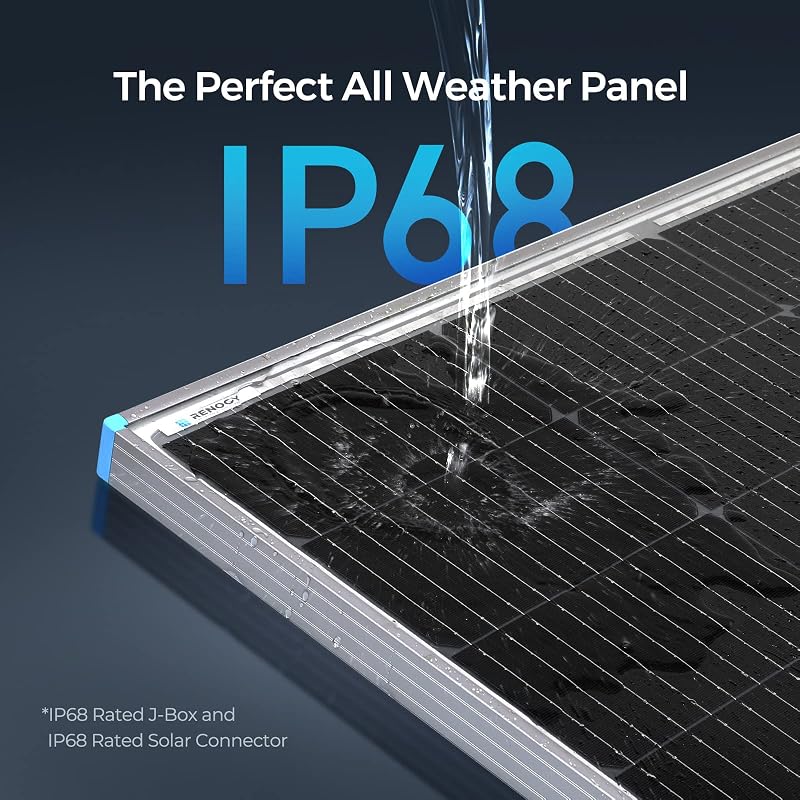
Also from the listing: the Renogy Bifacial 115W 12V Solar Panel. It is rated for 115W on a 12V system.
This image shows a Renogy 115-watt solar panel getting wet. Big blue letters say “IP68,” which means it’s protected from dust and can handle being underwater. The text at the bottom explains that the panel’s connection box and plug are also IP68 rated. This highlights that the Renogy solar panel is designed to work well even in tough weather conditions like rain.
Renogy Solar Panel Offers Long-Term Power Guarantee

Next, the Renogy Bifacial 115W 12V Solar Panel again. This image is from the seller’s gallery. It also has USB ports for charging small devices.
This image shows a Renogy high-efficiency 115 watt solar panel. It comes with a 25-year performance warranty. After 5 years, it’s guaranteed to produce at least 95% of its original power. After 10 years, that guarantee is 90%. Even after 25 years, it will still produce at least 80% of its initial power output. This means you can rely on this solar panel to generate electricity for a long time. The Renogy’s 100W panel is a comparable choice if you are still deciding.
Renogy 115 watt Bifacial Solar Panel: Compact and Powerful

Here is another seller image of the Renogy Bifacial 115W 12V Solar Panel. The seller states a warranty.
This image shows the Renogy 115 watt bifacial solar panel. It highlights its easy installation features. You can see the plug-and-play solar connector. The panel has 20 pre-drilled holes for mounting. It is smaller than a standard 100 watt panel. However, it produces 15% more power. The panel weighs 13.5 lbs and measures 30 inches by 30.9 inches with a thickness of 1.2 inches.
Versatile Bifacial Solar Panels for Various Applications

Last, one more image of the Renogy Bifacial 115W 12V Solar Panel from the listing. It uses monocrystalline solar cells.
This image showcases the Renogy Bifacial 115 Watt 12 Volt solar panel in different settings. You can see it powering a greenhouse or sunroom, providing energy for a motorhome, and being used on a boat for marine applications. Bifacial panels can absorb sunlight from both the front and back, making them more efficient at collecting solar energy in diverse environments.
Quick Summary
Renogy Bifacial 115W 12V Solar Panel in short. Positives: bifacial design; captures light from both sides; higher energy output. Negatives: needs careful planning; sophisticated mounts; tilt angle matters. Overall buyers are positive, though the drawbacks may matter depending on how you plan to use it. To compare, our Egretech 100W panel review is a good next read.
Frequently Asked Questions
What are the main specs of the Renogy Bifacial 115W 12V Solar Panel?
According to the product details: bifacial design; 115 Watts power; 12 Volt system; monocrystalline cells.
Should I buy the Renogy Bifacial 115W 12V Solar Panel?
Most buyers are positive. What they like: bifacial design; captures light from both sides. Drawbacks reported: needs careful planning; sophisticated mounts. Check these against your own needs before buying. For a similar option, see the Renogy 100W panel.
What are the pros of the Renogy Bifacial 115W 12V Solar Panel?
Buyers most often mention: bifacial design; captures light from both sides; higher energy output.
What are the downsides of the Renogy Bifacial 115W 12V Solar Panel?
The main complaints: needs careful planning; sophisticated mounts. A few other issues were mentioned as well.
Who should buy the Renogy Bifacial 115W 12V Solar Panel?
It fits buyers who care about the positives (bifacial design; captures light from both sides) and can live with the main drawback (needs careful planning). Shoppers who need more power may prefer the ACACIA 120W Portable Solar Panel.
More reviews you may like
- Renogy 50W 12V Monocrystalline Solar Panel
- Renogy 200W 12V Solar Panel & Z-Brackets (4)
- ACOPOWER 50W 12V Solar Panel
- Renogy 100W 12V Solar Panel Kit with Z-Mounts
Related Posts
Editor's note · Nov 2026
Here is something worth knowing. A 115W panel rarely gives its full rating in real life. Expect roughly 69 to 92 watts in good sun. PWM controllers cost less, but MPPT ones harvest more on cloudy days. Buyers' main complaint is needs careful planning. Weigh that against how you plan to use it. Check that the connectors match your power station or controller. Adapters add cost and loss. Check the panel size against your space. Foldable ones pack small but cost more per watt. To plan your setup, try our solar and battery sizing calculator.


